

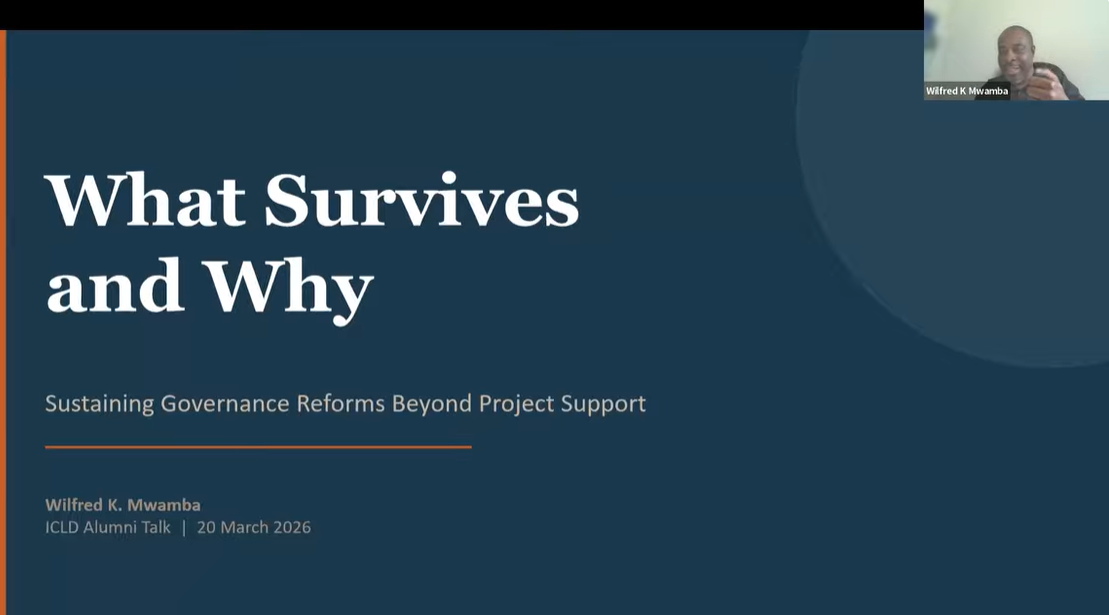
These tips distill key lessons from the recent ICLD Alumni Talk on pathways to institutionalise and sustain tools, practices and reforms in governance and service delivery.
The text is compiled by key speaker Mr. Wilfred K. Mwamba from The Policy Practice, drawing on contributions from practitioners across East and Southern Africa. Read more about Alumni Talks here.
1. Distinguish the tool from the reform — and design for the reform
- A Citizen’s Budget is not a communication product — it is a mechanism for building public legitimacy for revenue collection. A Citizen Report Card is not a feedback form — it is an attempt to change whether citizens can hold a council to account. SDG localisation is not a planning template — it is an effort to change what gets prioritised and funded.
- Where tools have survived, institutions internalised the purpose behind them. Where tools disappeared, projects managed the format without addressing the change it was supposed to achieve.
The test: does the institution behave differently — and would it keep doing so if the tool were gone tomorrow?
2. Build a coalition of champions — not a single sponsor
- Every reform needs people in authority who need it to succeed — not just people who approve of it, but people who would lose something if it stopped. A single champion is a fragile strategy. Champions get promoted, transferred, or voted out. The goal is a coalition — elected leaders, senior officials, civil society organisations, and citizens who each have a different reason to protect what the reform delivers. When the mayor moves, the finance director still cares. When the finance director moves, the community still asks.
- When no champion currently exists, the task is to create conditions that attract them — not to wait. Start with problems leaders already need to be seen solving. Give credit publicly and deliberately. Know Your Neighbour in Lusaka had no political champion at the start. Politicians came after they saw the community response.
- Civil society organisations face a related challenge: how to maintain relationships with government without being seen to take sides. The answer is not to avoid government but to work with it deliberately — using closed-door conversations to build trust, being transparent about findings, and building a coalition broad enough that the reform is not identified with one political actor.
Action: Map the reform’s coalition. Name at least three people — at different levels of authority — who would lose something if the reform stopped. If you cannot name three, that is the gap to close before the partnership ends.
3. Find the fiscal argument — and frame it in the institution’s language
- If a reform depends only on project funds, it ends with the project. A Citizens Budget that increases revenue compliance has a fiscal argument: citizens who understand how their money is spent are more likely to pay. Participatory planning that reduces dispute costs has one too. Find it, put a number on it even if approximate, and present it before the handover conversation begins.
- Reforms that speak to what the institution already values — revenue targets, accountability obligations, planning cycles — survive political transition better than reforms framed in programme terminology.
Action: Calculate what the reform saves or generates. Present it in the next budget discussion. Frame it in the institution’s language — not the project’s.
4. Manage the change, not just the task — and build into what already exists
- A common challenge: how do you ensure staff actually sustain reforms beyond the project, given that people move, priorities shift, and lessons from previous projects fail to carry forward? Embedding reforms in job descriptions is necessary but not sufficient. It requires change management — from the start of the project, not as a closing activity.
- Institutionalisation is not an event. It is a process of shifting behaviours, reinforcing new practices, and making the reform part of how the institution thinks and works. That requires attention to who needs to do something differently, what accountability exists for new behaviour, and whether the performance environment recognises those who carry the reform forward.
- The second risk is parallel structure. New committees and platforms built specifically for the project become visible as project outputs — and disappear with the project. Build into what already exists: ward committees, budget cycles, reporting structures. Know Your Neighbor used existing ward structures in Lusaka, not new ones. That is why it held.
Action: Name the role that should own this reform when ICLD has gone. Get it into their existing performance agreement. Then ask: what behaviour needs to change — and what accountability structure will reinforce it?
5. Activate citizen demand — and recognise that context shapes what works
- Supply-side reforms without demand-side pressure are fragile. When citizens, civil society, or local media begin to reference and use the outputs of a governance reform, it acquires a constituency. A Citizens Budget that citizens reference in public meetings is far more durable than one that sits on the council website.
- What activates demand differs significantly between contexts. In rural areas, the support of traditional leaders is often essential. In urban areas, reaching younger citizens — and treating them as active participants rather than recipients — is critical. There is no single model. The design needs to fit the community being served.
- Citizens are not the audience for reforms — they are co-producers. Where they are involved in identifying problems, shaping solutions, and holding institutions to account, the reform is more likely to survive a change in leadership or a shift in priorities.
Action: Identify one citizen-facing moment in the next six months where the reform’s outputs can be made visible and actionable. Design it to generate a claim — not just awareness.
6. Build for ownership from the inception — not the handover
- Ownership cannot be transferred at handover — it is built throughout, or it is not built at all. Co-creation of outcomes and outputs should be a component of project design, not an add-on. That means spending more time at inception: understanding the context, connecting the reform to local development plans and budget cycles, and asking what reforms make sense for this institution with these staff at this moment.
- An honest conversation at the outset about what the project can and cannot deliver is more respectful than a confident project plan that quietly shifts responsibility at the end. The question to ask at inception is the same as the question to ask at exit: if we withdrew tomorrow, what would break? Build the partnership so the answer keeps getting shorter.
Action: Run the five conditions (political utility, institutional fit, fiscal anchorage, staff routine, citizen demand) as a self-assessment. Score each honestly. Address the weakest one first — now, while the partnership is still active.
Could you lose the tool tomorrow — and would the reform carry on? If yes, you have institutionalisation. If no, you have a design gap. And design gaps can be fixed.