

Sustainable Water Management through Local Expertise and Community Inclusion
The partnership between Ronneby and Ternopil focuses on sustainable water management, particularly access to clean water and stormwater handling—critical components of local democratic resilience and SDG 11 (Sustainable Cities and Communities). Recognizing the complexity of these issues, both municipalities have involved experts within their local administrations. Engineers, municipal staff, and local civil society organizations (CSOs) have been engaged in a peer-learning process that has led to increased knowledge sharing on water challenges and best practices.
Through thematic seminars and staff exchanges, both cities have developed a deeper understanding of how stormwater affects different population groups and how to identify those most vulnerable. Ternopil, for example, has begun to integrate accessibility into urban design, such as ensuring that sidewalks are safe for people with disabilities and caregivers with strollers. The work is in its early phases but is laying the foundation for inclusive planning.
On the organisational side, the partnership contributes to information processing, information sharing and community participation. Ternopil has started to map out vulnerable groups and has made efforts to include them in water-related dialogue. Both cities have acknowledged the need for better stakeholder engagement, and plans are in place to develop networks involving CSOs, municipal workers, and citizens. Ronneby is drawing on its experience in public education to create materials and outreach methods that can be adapted for the Ukrainian context.
Despite differing geographies and water absorption capacities, the two cities face similar challenges in managing intense rainfall. They’ve discovered that small-scale, localized solutions based on site-specific analysis can be effective across contexts. In response to long power outages, Ternopil has installed public pump stations and, with support from Ronneby, uses generators to power water infrastructure during blackouts.
The dialogue continues to evolve, and both municipalities are exploring new avenues for cooperation, including scaling the work and aligning with national water strategies in Ukraine and EU-standards. The partnership stands as a promising model for integrating environmental resilience with community engagement and mutual learning.
This partnership is part of the ICLD Network for Democratic Resilience
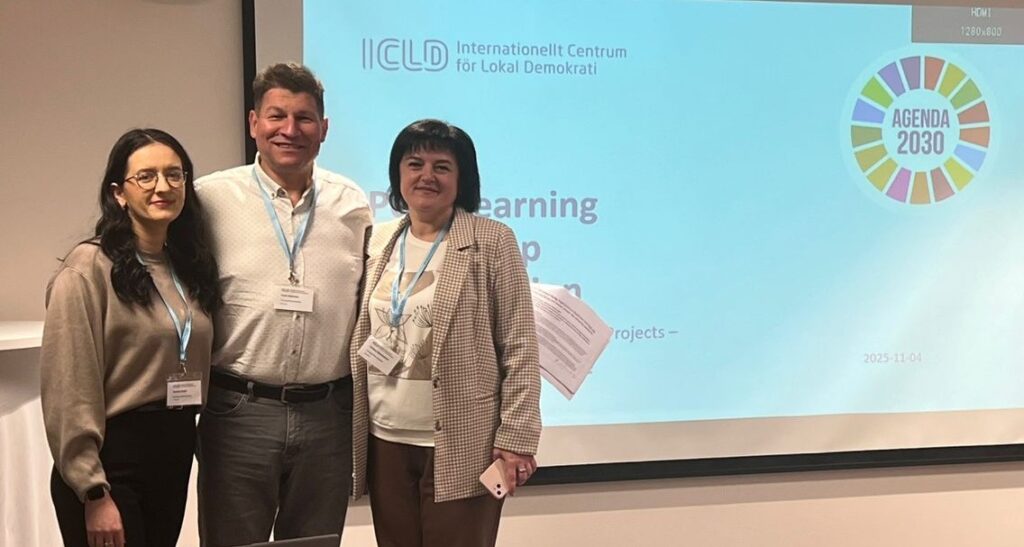
The Ronneby-Ternopil delegation during the fourth DR Network meeting in Tallinn, 2025