

Building Better Cities Together
The partnership between Jönköping and Berdychiv focuses on strengthening citizen participation and digital innovation in urban planning. While technical foundations for city planning are already in place, they are now incorporating democratic tools—especially citizen dialogue—to ensure inclusive development of new urban districts.
In Berdychiv, guidelines for citizen dialogue already exist, and the aim is to make all urban planning tools transparent and participatory. A broad societal perspective underpins this ambition, ensuring that the urban development process becomes both modern and inclusive. While still in the planning phase, the initiative signals a significant step toward embedding democratic practice at the local level.
In Jönköping, there is recognition that Swedish planning standards cannot be directly applied in the Ukrainian context. Therefore, a mutual learning process is underway. The most recent exchange visit helped refine the future direction of the project, which aligns with SDG 11 (Sustainable Cities and Communities). At the participant level, the partnership has focused on collaboration, digitalisation, education, and public dialogue. Notably, Jönköping’s Technical University of Engineering is involved and will use the geographical data from Ukraine generated from this project in their GIS-courses.
A key methodological tool being introduced is MyPlace, developed in Malmö and designed to engage youth in local planning processes. Other partnerships from the DR Network have already expressed their interest in this tool and want to use it in their upcoming project cycle to strengthen youth participation.
Another innovation is the development of a digital citizen engagement app in Berdychiv, expected to launch by the end of the year. Its primary function will be to facilitate digital citizen input through surveys and suggestion boxes. This aligns with Berdychiv’s push to enhance external communication and public participation via digital tools. The app will also include practical services like utility payments and public transport features to ensure regular use—a strategy inspired by similar efforts in cities like Ternopil and Odessa.
Despite some structural challenges the collaboration continues to thrive. Jönköping has been positively surprised by the high level of digitalisation in Ukraine, such as the widespread use of digital ID systems.
From an organisational perspective, the project targets staffing and cross-boundary collaboration and information sharing. Progress is being made, including cross-sectoral partnerships with educational institutions to enhance competence.
The challenges lying ahead are to ensure that incoming data from citizens is processed and used as decision-making material, and to build structures that allow for formal feedback and continuous democratic involvement. In Jönköping, citizen input is currently used by technical departments in early planning stages but is not yet integrated into political decision-making. In contrast, Berdychiv is actively exploring how to involve citizens in shaping the city’s future vision.
The collaboration is further enriched by shared training material developed in Jönköping, now subtitled in Ukrainian, and targeted at urban planning specialists. This material—especially modules on visualisation and digital information—is highly relevant for Ukrainian municipalities involved in reconstruction.
The partnership creates momentum for further projects and reform, paving the way for increased democratic resilience in both municipalities.
The partnership is part of ICLD Democratic Resilience Network.
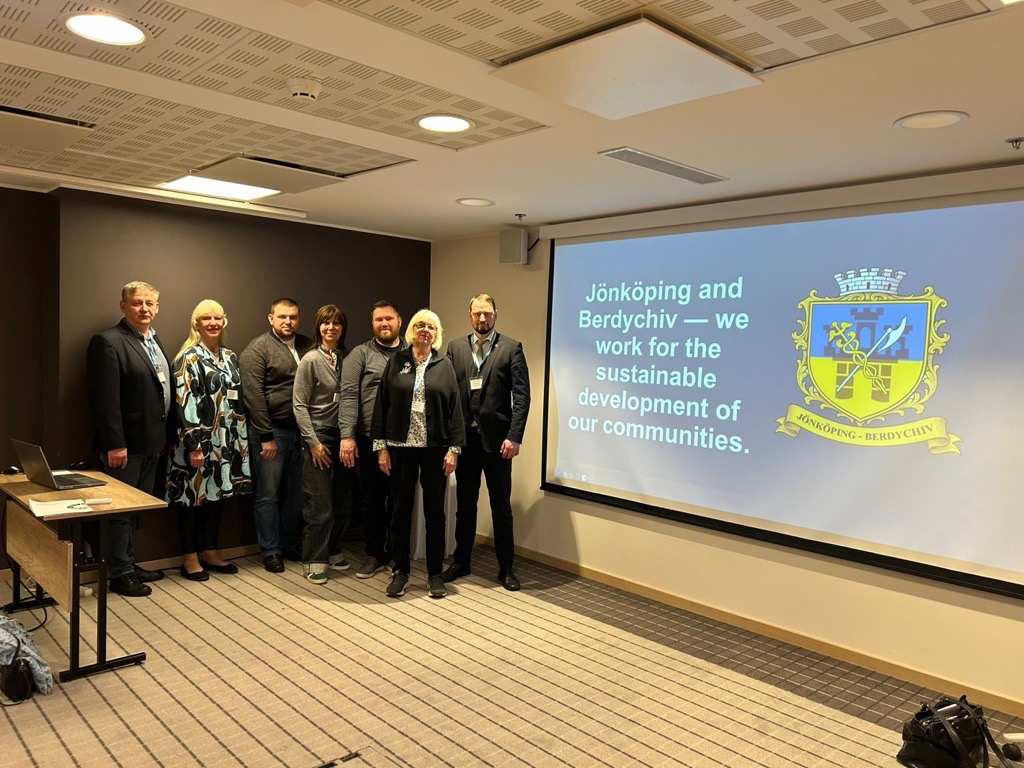
The Jönköping-Berdychiv delegation during the fourth DR Network meeting in Tallinn 2025