


Strengthening Child Rights and Inclusive Communication
The partnership between Västerås and Shatsk has deepened through two exchange visits to Västerås, with a strong emphasis on children’s rights—particularly in relation to the right to safety in bomb shelters. The collaboration has contributed to interregional knowledge sharing, capacity building, and civic engagement, especially among youth.
A notable achievement includes a youth dialogue, a short story competition for children and a collaboration with Europe Direct that has elevated the partnership’s visibility through local media. A visit to the Swedish Parliament further reinforced understanding of political governance among participants.
The partnership has also contributed to knowledge development in several key areas:
- Child Rights and Digitalisation: Participants gained insights into integrating child rights perspectives and statistical data into local planning and digitalisation strategies.
- Improved Communication: Training enabled participants to apply statistics on vulnerable groups to design inclusive and targeted communication strategies.
- Psychosocial Support: Staff were trained in creative writing as a form of psychological first aid, already tested at the Shatsk art school.
- Citizen Dialogue: Needs assessments collected citizen feedback—such as safety concerns regarding school routes—leading to more inclusive decision-making processes.
Strategically, the partnership has enhanced peer learning and mutual inspiration. Both sides report having learned about citizen-centred communication, flexibility, political support, and methods for citizen inclusion. They have also participated in peer learning exchanges within the DR network, receiving structured feedback aimed at increasing the long-term sustainability of the project.
A key focus moving forward is the systematic integration of child rights into policy planning, along with expanding to other areas. Improved information management strategies are being developed, and digital communication initiatives, including the use of social media to reach youth, are in progress.
The collaboration has also mobilised local resources. For instance, a donation campaign in Västerås led to the delivery of a skylift to Shatsk, directly linking community needs to practical support.
Efforts to strengthen citizen participation are ongoing, with plans to co-develop educational materials. Strategic anchoring is evident in the adoption of a new long-term development strategy in Shatsk, which includes contingency planning based on various future scenarios linked to the war.
In sum, the Västerås–Shatsk partnership demonstrates a broad, strategic, and inclusive approach to child rights-centred crisis preparedness, and knowledge exchange, reinforcing the values of resilience and community-led development.
The partnership is part of the ICLD Network for Democratic Resilience.
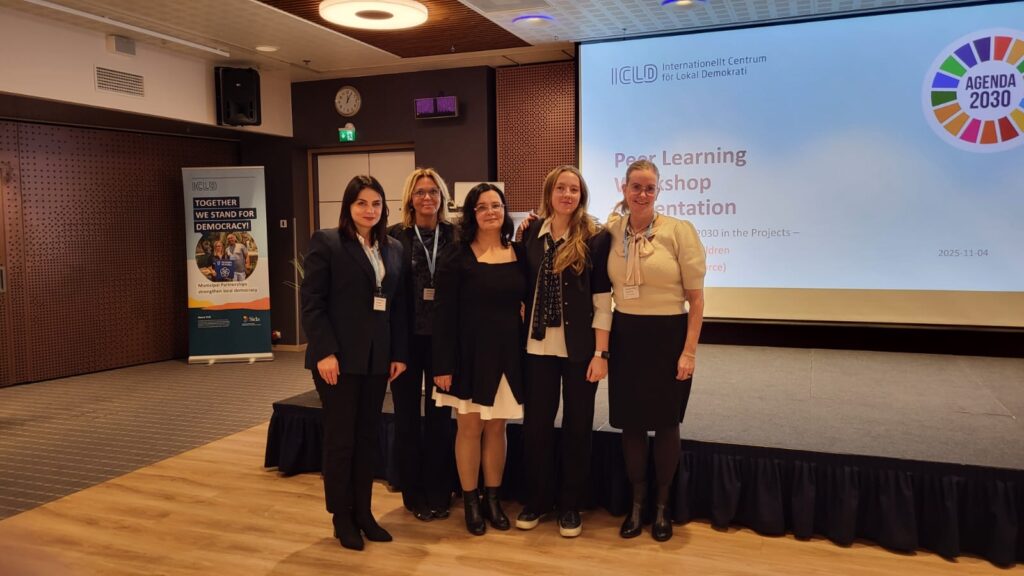
The Västerås-Shatsk delegation at the fourth DR Network meeting in Tallinn, 2025